Smart Plugs: The Cheapest Way to Automate Your Home
No smart home device delivers more value per dollar than the humble smart plug. For the price of lunch, it makes any appliance app-controlled, voice-controlled, and schedulable. The catch is knowing which plug does which job — because a $12 mini and a $22 outdoor model are built for very different lives. Here's the complete picture.
What a Smart Plug Actually Does
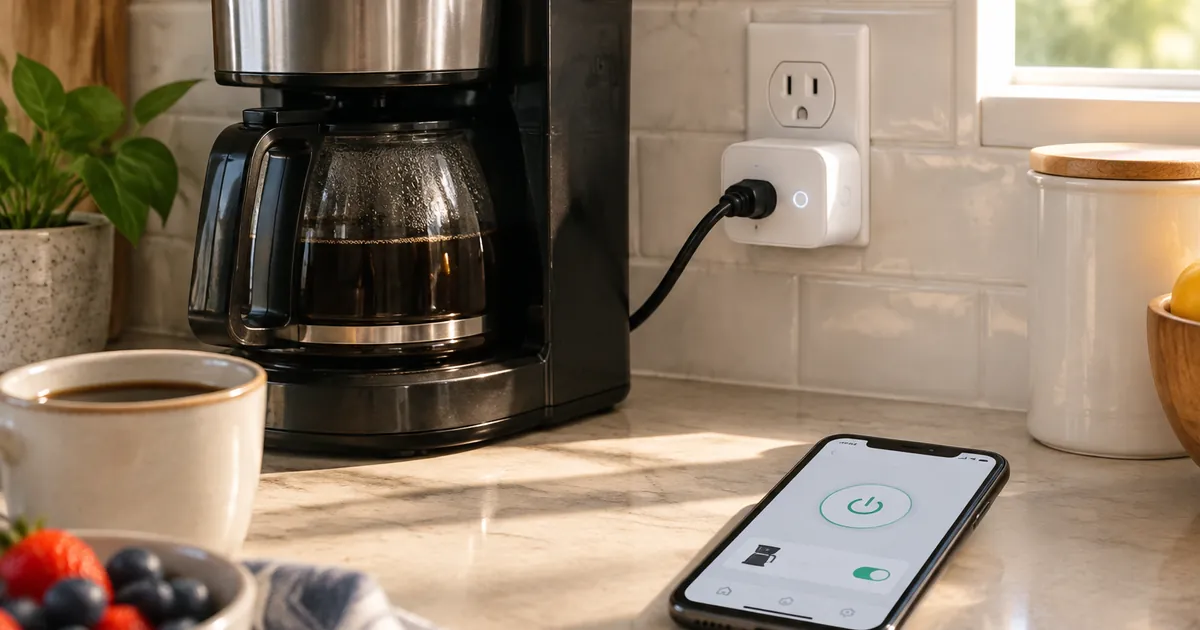
It sits between the wall outlet and your appliance, cutting power on command. That's the whole trick — and it's enough to automate lamps, fans, coffee makers, humidifiers, holiday lights, fish tank lights, and the iron you're never quite sure you turned off. Every plug in our collection works with Alexa and Google Home over standard 2.4GHz Wi-Fi, no hub needed.
The Four Jobs (and the Right Plug for Each)
1. Everyday indoor automation → Mini
The Smart Plug Mini ($12) is the workhorse: compact enough that two fit in one outlet, ideal for lamps and small appliances. Buy these in pairs — one for the coffee maker, one for the lamp you never remember to turn off.
2. Finding your energy hogs → Energy monitoring
The energy-monitoring plug ($20) shows real-time wattage and monthly cost per appliance. Point it at the suspects — the old fridge in the garage, the space heater, the entertainment center — and you'll find one device paying for the plug within a month. Knowledge is where the savings start.
3. Outdoors → Weather-resistant
The outdoor dual-outlet plug ($22) handles holiday lights, patio string lights, and pond pumps. Weather-resistant housing, two independently controlled outlets — your Christmas lights get a schedule, and the patio stays one voice command away all summer.
4. Voice-first homes → Voice-control plug
The voice-control plug ($18) is optimized for fast voice response — the one you want when "Alexa, turn on the fan" is the primary interface.
The Schedules That Earn Their Keep
- The coffee maker: start brewing at 6:45 so the pot is fresh when the kitchen opens. (Use a mechanical timer mode or leave the switch on — check your model.)
- The space heater: on at 5:30pm, off at 11pm. Never trust a heater to memory.
- The curling iron / iron: a plug that cuts power at 8am is cheap insurance.
- Holiday lights: dusk-to-midnight all season, never touched by human hands.
Smart Plug Safety: The Honest Limits
Smart plugs are rated for 15 amps (about 1,800W). Everything on a desk, in a living room, or on a kitchen counter is fine. What doesn't belong on a standard plug: electric dryers, water heaters, and other hard-wired or high-draw appliances. Space heaters are the gray zone — modern heaters under 1,500W are within spec, and the schedule benefit is real, but buy a quality plug and never daisy-chain plugs or power strips. When in doubt, check the appliance's wattage label against the plug's rating.
The two-plug starter recommendation
If you're buying your first two: one mini for a lamp (instant daily win) and one energy-monitoring model for the appliance you suspect is expensive to run. The first sells you on convenience; the second usually finds a surprise. Between the two, you'll know whether your next $20 goes to more plugs or a thermostat.
Frequently Asked Questions
Do smart plugs work with any appliance?
Anything that plugs into a wall and draws under the plug's rating (usually 15A / 1800W — fine for everything except large kitchen and shop equipment).
Do they use power when idle?
About 1W to keep the radio alive — roughly $1 per plug per year. The energy-monitoring model accounts for this in its readings.
Can I control them away from home?
Yes — the app controls plugs over the internet, so the "did I leave the iron on?" panic is solved from anywhere.
Beyond On/Off: The Routines That Feel Like Magic
Once plugs are in, the routines are where the smart home stops being a gadget and starts being infrastructure. "Goodnight" kills every lamp, the TV setup, and the coffee maker's standby draw in one command. "I'm home" brings the living room lamps up before the door closes. Vacation mode cycles lights on random evening schedules so the house never looks empty — a trick that used to require a $100 mechanical timer wall, now a checkbox in an app. None of this needs a hub or an electrician; it needs one more $12 plug than you currently own.
The Bottom Line
Start with the $12 mini and automate something today — free shipping makes it painless.